Although in my opinion their work hasn't exactly been a huge improvement so far. It's just a flatter coat of paint with the same issues that already plague KDE: inconsistent padding and spacing, terrible organization (think system settings) and so on.
The redesign is not in this beta and, depending how long it takes, maybe won't make it into the first final release either.
Partially it's even by design. It's not intended that Plasma 5 diverges too much from the current release to ease the transition.
Canonical never contributed much to KDE. Yes, a few bits here and there but overall mostly negligible.
Blue Systems OTOH is a big KDE contributor. Things like KDE Search improved a lot thanks to Blue's involvement.
As for Kubuntu: It appears to me that mostly the same people are involved with it. The only KDE thing mostly specific to Kubuntu is Muon (and that's being ported to Debian as we speak). Everything else by Blue Systems is AFAIK cross-distro.
The Kubuntu guys already announced that Canonical's own display server Mir is not an option. Therefore it remains to be seen how feasible Kubuntu remains with Canonical pushing a Wayland competitor.
Last time I used KUbuntu it was pretty much horrible. (E.g. only 6 month maintained and after that the repo did go offline so my installed system was broken (couldn't even install old pkgs from the DVD because of dependencies)). But the config tools from SuSE where also horrible (convoluted and so slow!), so I use the Fedora KDE spin now.
Having used both zypper and apt-get, I find the latter very lacking, even when coupled with other tools.
Take `zypper se -s`, for example - or if you prefer the long form, `zypper search --detailed`. How do you get that information from any of the apt tools, or even aptitude?
And then there's the openSUSE build system.
But I digress. I will attempt to replace my openSUSE installation with NixOS and if I miss my automatic KF5 builds, I'll try to create Nix packages for them.
That's not me, that's a well known general design principle: "It seems that perfection is attained, not when there is nothing more to add, but when there is nothing more to take away."
I did a lot of Linux desktop stuff 10 years ago. Now I feel most of the action takes place inside the browser. KDE's biggest contribution to computing will always be KHTML.
Yes, I read it and I know the settings are being redesigned. The system settings is just one example and perhaps the most egregious. It's also the one that is still a constant annoyance after years of using KDE when trying to find something.
Try a different heavy DE and see if you can even find the settings these days. I hadn't used KDE since back when they first released 4 and have just started using it again. I'm loving it - a heavyweight DE where things are properly integrated (sorry XFCE and similar) and that you can actually personally tune the settings for. The settings can be a little difficult to find... but at least they're there to be found :)
Seriously, it was a rhetorical statement that didn't mean "no-one can literally find the settings", but "you're not allowed to change much these days". Gnome 3.x in particular is horribly bad. KDE allows a lot of tweaking.
I sort of guessed, but decided to answer literally because people can just find a GUI that works for them on Linux can they not?
My understanding of Gnome desktop is that customisation is being offloaded to third party extensions. I admit rapid changes in API for extensions means breakage at present, but I'm hoping for asymptotic stability as the interface matures. When that happens it will be like visual emacs one hopes... hack on your GUI for the things you need.
It is? My girlfriend uses KDE, and I never found difficult to find stuff using the integrated search. On the other hand, if they would recreate print settings, I wouldn't have to explain that typing http://localhost:631/ in a browser is the most intuitive way of managing printers.
That he has someone close to him that uses it that doesn't mind when he jumps on the system, so he does it occasionally? There may or may not have been something implied by stating his/her girlfriend used it, but assuming a negative implication does not lead to useful conversation, IMHO.
Note that the wheeldesigners are just making a new default theme. With minor tweaks all kde 4 series themes are still usable.
Also, the inconsistencies are mostly due to app developers themselves. The difference between plasma and the software compilation can exemplify that - you use two entirely different application stacks if you are developing for one or the other (qt widgets enhanced by kdelibs vs qml enhanced by plasma). And then there are multiple ways to actually develop the app interfaces - you can use anchor based widgets, ui files, or raw custom positioning which I find in reviewing a lot of codebases a bit too common for my liking.
When I have the time I try to fix it, though. The problem right now is that while the Qt world's future is QML based, the KDE applications and libraries were developed for over a decade around widgets. So when I develop something new I'm using QML and it can scale, animate, and orient really well for arbitrary window sizes and devices, but some widgets applications just anchor a toolbar to 50px indents and then it looks like puke on high DPI.
I mean you can still do that in QML, but the anchors and layouts are so easy to use it seems insane to do so.
Their icons are not good. Too glassy and cartoony and too many gradients. They don't look modern, they look like icons for a kids app from 10 years ago.
They are planning to adopt Font Awesome as the default icon theme. Right now they are still using the old Oxygen set.
And at that, you can pick your own icon themes anyway. There are Hycons, Numix, Faenza, etc. I do agree defaults matter and the Oxygen icon set is gaudy, but it shouldn't stop an HN user from trying it since you can change them.


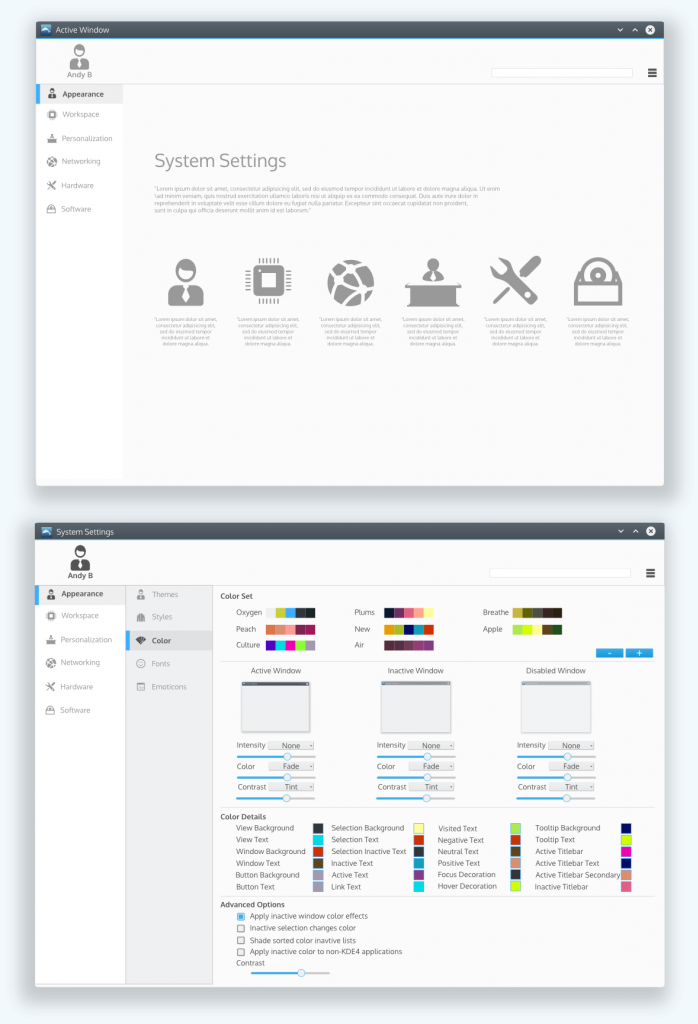
Although in my opinion their work hasn't exactly been a huge improvement so far. It's just a flatter coat of paint with the same issues that already plague KDE: inconsistent padding and spacing, terrible organization (think system settings) and so on.