Have they considered some kind of super heavy gravitational mop. Something big enough to attract enough small particles and just 'mop' them up and send them into the sun or towards Earth?
I'm sure the idea has been considered - and then ignored as completely ridiculous when you do the math.
The biggest rocket ever built (the Saturn V) could take 140,000kg to low earth orbit. That's nowhere near big enough to have any kind of significant gravitational attraction to "mop" objects away from their orbits. Some kind of magnet would be more feasible, but still not practical because operating a huge magnet in the Earth's magnetic field would affect the spacecraft itself.
Finally, once you would have "mopped" these objects into neat bunches, it would take 4 km/s additional velocity to escape the earth and a whopping 30 km/s to send things towards the sun (without any gravitational slingshot). Now you can calculate the amount of propellant (using the Rocket Equation) that it would take to send any meaningful payload that distance.
Things there move fast in orbits, the gravitational attraction can't just "collect" them, not more than the Earth can. For example, ISS travels 17 thousand miles per hour, or 5 miles every second. Moving the "big and heavy" object around is of course much harder and energy demanding than moving the smaller objects themselves and the gravitation is unbelievably feeble force compared to all others.
The article gives the examples of the cheapest solutions already. It's impossible to imagine more expensive approach than using any other gravitation than Earth's.
If you read the article all the way to the end, there was a suggestion of using aerogels to do exactly what you propose. But this was among the most expensive methods suggested.
It requires energy to move objects in space, you'd need to add velocity (in the order of kilometers per second) to move objects out to a graveyard orbit. And once they are at a graveyard orbit, nothing would make them "spiral out and away" from earth. The lunar gravity is not strong enough at practical altitudes to do this (this is known as a Lissajous orbit [0], used sometimes to put objects to Earth-Moon L2 point).
Geostationary satellites are put into a graveyard orbit a little bit above the geostationary orbit (but they stay there).
Moving objects from lower altitudes up is not feasible due to the propellant requirements and the fact that the old satellites/debris are not made for that.
And you can't just chuck stuff away from Earth either (that needs 11km/s of velocity w.r.t the Earth in the first place), they will remain in a heliocentric orbit near the Earth and perturbations from the Earth, the Moon, and the planets may bring those objects back, travelling at interplanetary velocities. For example, the S-IVB stages of Apollo missions were sent to heliocentric orbit (with a gravity assist from the Moon), but the third stage of Apollo 12 eventually came back to Earth orbit in 2002 (and may come again in 2040) [1]
Let's clean up our oceans first? That plastic island out there has irritated me for years. Oh yea--and maybe stop eating so much fish? That includes Sushi. I had a girlfriend who called herself a strict vegetarian, but fish
don't matter. Yea, we had numerous arguments about the power of denial.
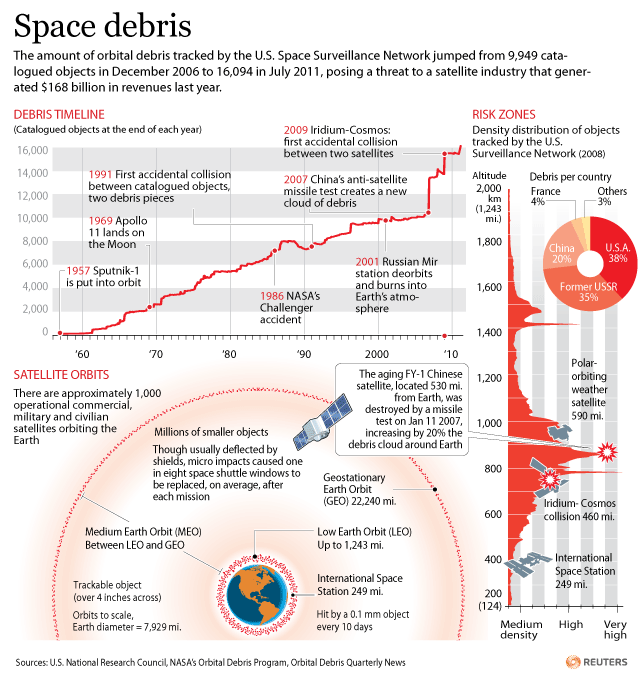
This article is junk. It describes in very alarming way space junk, but it never even mentions atmosphere drag at LEO and natural orbital decay. ISS has to periodically increase its orbit and it already brought down Skylab and to some extend Mir.
> and amped the volume up to 11 for dramatic purposes. The filmmakers kept only as much science as they felt like keeping
> We’ve already reached the point where the growth of debris in low Earth orbit (LEO) has become self-sustaining.
The influence of the atmosphere on orbiting objects is enormously dependent on altitude. Manned spacecraft usually orbit at extremely low altitude because they tend to be heavy and the tradeoff of regular reboosts is mostly worth it (manned space stations need regular resupply anyway). However, whereas the orbital lifetime of the ISS may be measured in mere years even just a few hundred km higher increases lifetime to centuries and beyond that to millenia.
You can see that most of the debris below 700 km has naturally been culled by aerodynamic drag, but above that altitude there is still a large amount of debris, most of which has an expected natural lifetime of many centuries.
In the article, two specific bands of altitudes are mentioned: "orbital junk in two bands of LEO space—the 900 to 1,000km (620 miles) and 1,500km (930 miles) altitudes—already exceeded the necessary density."
There is hardly any atmospheric drag at these altitudes. The ISS is (and Mir and Skylab were) only half of that altitude and even that would survive for years before naturally re-entering due to orbital decay from atmospheric drag.
The problem of orbital debris will not sort it self out given enough time. It is already a hazard to manned spaceflight as well as satellite operations.
I thought the self-sustaining bit (which is a terrible description) referred to the increase in space junk over time, compared to the period over which they were saying it was in decline (prior to people getting interested in blowing stuff up in space).
The problem will not solve itself if it's ignored. All the current calculations of future positions of course include the effects of the changes of the orbits.
The reached tipping point they mention is that the current objects will collide often enough to continually produce even more debris. That means that the generation of the new objects happens certainly much faster than the burning in the atmosphere.
"today, the catalogue contains about 13,000 objects, or more than 3 times as many objects. This gives a collision rate that is more than 10 times what it was just over 30 years ago, or 0.13 per year….which is the same as one catastrophic collision between cataloged objects every 8 years….with the time between collisions rapidly becoming shorter as the catalog continues to grow. The larger fragments from either explosions or collisions will further accelerate the rate of collisions."
Only if we stopped putting more crap up there for those few decades (where a "few" is probably more on the order 10 to 100 ... yes, decades). Human exploration and exploitation of space resources is far too important to the short and medium term benefit of mankind — leaving entirely aside its implications for our long term survival — to wait it out.
Or put it another way: the GPS system is used to synchronize power phases, guide aircraft, cars, people, ships. It's built into emergency transponders, military drones and bombs.
Without that system, we're back to compasses, line of sight and dead reckoning. We lose the current insane advantage of realtime positioning anywhere on the planet.
That's 1 18 satellite system - and we absolutely can't run a modern civilization without it.
Actually, nowadays a system of ground stations and high altitudes atmospheric floating balloons can be made to serve the very same purpose. The ground stations would serve for triangulation of balloon's position and those at their turn could serve the rest of the service-consumer base. As a bonus, the balloons would be obviously more manageable compared to satellites, the cost of taking them into operation would be of course much lower (no more atmospheric pollution), and be disposed cleanly without causing the problem discussed in the article.
I think your estimate is overly alarmist. Without GPS, we'd use ground-based stations. It wouldn't be as accurate or as available, but it would still be good enough for almost everything GPS does. In fact, we already have ground stations to augment GPS. And even without ground-based stations, modern accelerometers allow inertial navigation to be quite accurate.
Also, GPS satellites are in medium Earth orbit, which is rather sparsely occupied. In a Kessler syndrome scenario, GPS would likely survive.