The next step is to work on cleaner electricity. While most EU got the message long time ago, eastern bloc countries are much behind. Currently in Poland it is better for the environment to drive a diesel VW Golf than Tesla, as the electricity is produced from brown coal.
That's not true. Even with coal, the end-to-end emissions are better with electric cars.
Proof: Poland is 800gCO₂/kWh [1]. With an average electric car (i.e. my hyundai ioniq), you average 11kWh/100km, or .11kWh/km. Taking emissions into account, that gives us 88gCO₂/km.
Also, that 120gCO₂/km doesn't take into account the CO₂ emissions for the electricity for the refinery to make the diesel. Or the transportation of the diesel.
11kWh is kind of generous - I mean I believe you, because I've been following a Facebook fanpage of an Ioniq owner in Poland and his numbers are very similar, but I think it's due to the car's amazing efficiency comparing to the competition.
If car A produces 1 tons of emissions to build, and 100 tons over its life, and car B produces 2 tons of emissions to build, and 50 tons over its life, car B is the better one for the environment. (52 < 101)
Looking at emissions to build as a metric by itself is disingenuous, you should look at lifetime emissions instead.
If you consider that the new car in Poland will be on the road for 10-15 years, it's still better to buy an electric car instead. They will exit coal soon, and in a few years the EV will be greener to operate.
I thought cars these days last 200k miles easy, probably 300k+ with minor repairs. At 15k miles per year, that should give at least 15 years of use, but I would hope the average was more 20+.
I agree, in some cases 15-20 years, or more, might be possible. Depends on how easy/cheap to replace all the parts are - seats will wear out, the headliner will have accumulated all kinds of stains and grease, random electronics (a modern car has ~100 microcontrollers) might fail and be hard to access, AC might be expensive to fix, maybe the battery dies and (even if the batteries are cheap by then) the mechanic charges 1k for the replacement...
At some point it's probably cheaper to buy another used 8yo EV than continuing to maintain an 18yo EV.
You're not considering the local nature of the emissions and diesel's dirtier effect on organisms. How much closer are the cars to the populace, relative to the power plant?
And you are ignoring that electric cars produce fine dust particles from their brakes and tyres as well.
The fine dust is actually a much more serious problem in the city than combustion engine emissions as the latter are passed through particle filters and the catalyst.
Sadly you're asking the poorest countries in the EU to completely overhaul their energy production. While that will happen, it'll take a longer time on average.
Germany is one of the dirtiest producers of electricity in the European Union with 400 grams of CO2 per kWh on average while France emits 50 grams of CO2 per kWh on average.
Poland is actually planning to build nuclear power plants while Germany is permitting the shutdown of coal-powered plants plus building 17 new gas plants.
Thus, Poland’s electricity will eventually be cheaper than Germany’s.
The EV market in Poland is extremely small for a 38mln country, so I believe that by the time it reaches appropriate size the scale will tip in favour of EVs - after all we're bound by EU emissions targets and the associated CO2 market.
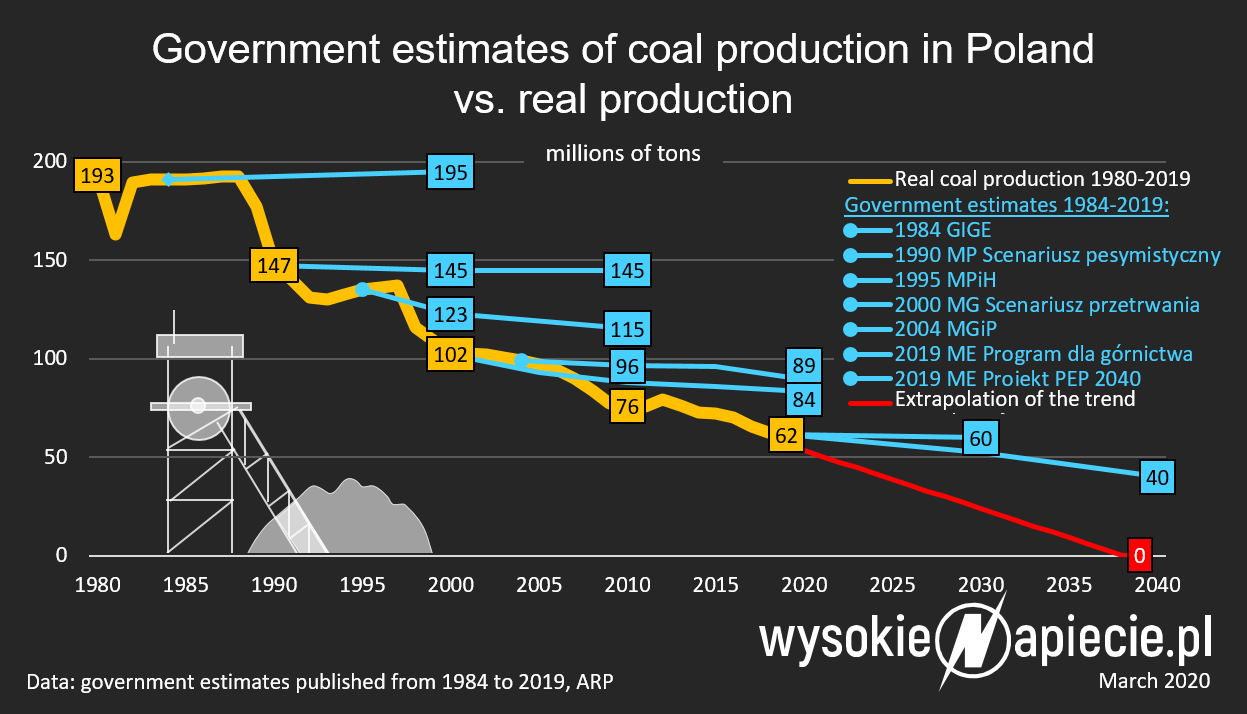
Brown coal has been declining in Poland faster than anticipated:
It is being replaced by imported hard coal, but that's still some improvement.
There are also plans for offshore wind, because I believe they finally found a crony that would like to pick this up and make money on government projects.
There are plans for nuclear, but let's just say that there have been for years now and they didn't even manage to pick a site, even though there's a half-finished concrete reactor hull(block?) from the communist era available.
Why does coal have such staying power in Poland? I've heard all about their coal reliance, is it political powers and mining powers who keep it that way? How is air quality and asthma in the country?
In the past it was because we had 400k+ coal miners who were very well organised, so any attempt to touch the coal industry resulted in protests and literal tire fires in Warsaw.
That number went down to 80k by 2020, but they still vote in concert, so any governing party has to tread lightly.
Nowadays it's just that there's a lot of old infrastructure - both power plants and residential heating and noone wants to step up and replace it, because that would mean additional costs - we're a stingy folk.
As a result the coal industry is currently being subsidised to the tune of 9bln PLN (€2bln) annually.
As for air quality: during the winter it's just awful - mostly because of homeowners who burn coal dust and garbage for heating.
I live in Wrocław and bought an air purifier in September, but already had to replace the HEPA filter that was supposed to last a year, because a week of PM2.5 over 200ug/m3 was enough to clog it entirely.
Poland is planning to build six nuclear reactors in the near future.
One of the biggest consumers of coal within the EU is actually Germany which have a rising reliance on fossil fuels due to them shutting down nuclear power plants.