That's ridiculous. If you buy T-bills today your don't even keep up with inflation. Rich people need to make long term investments to stay rich, they can't take money out of the system or inflation eats it.
Further, paying capital gains at say 50% on 10% returns for 20 years is better than paying 0% capital gains on 6% returns for 20 years.
Let's ignore the fact that If people rush into these other assets like you claim, it would impact their price and return profile. The key question is which chunks of the monetary system "go away." Are those chunks a net benefit for society in the first place or simply a tax deferment/avoidance vehicle for the rich?
Take the recent corporate tax cut, which made companies flush with cash. Companies could invest that in 4 main buckets: pay down debt, invest in growth (r&d or acquisitions), pay out bonuses to workers or buy back stock/declare dividends.
Let's say the company has 1,000 employees and gets $1 million in new cash flow from the tax cut. They have little debt and no direct acquisition targets so they are now deciding between giving all employees a $1,000 bonus or buying back $1 million worth of stock.
Since bonuses are taxes at regular income rate and dividends/capital gains are taxed at 15%, the tax efficient way to put that money to use is through buybacks or dividends. The people making the decision are likely executives with high salaries (income tax rates) and large stock portfolios. They will only pay 15% tax on those dividends compared to the bonus option where they would likely pay at the highest income bracket.
Who gets the short end of this dynamic? Workers who helped create that revenue, but can't afford to buy enough stock to get $1,000 of benefits. The tax code has disincentived the company from rewarding its employees in favor of rewarding its investors. Again, people who are already wealthy tend to be the investors rather than those who typically labor for their income.
If there is no tax incentive the investing in new start up companies eg (fever tree in the UK)
Then rational investors will avoid risker share investments in new companies it will reinforce the position of incumbents who will be forced to pay out more in dividends and become bond proxies.
Where you are making a mistake is riskier investment have a risk premium. Further, you can offset capital gains with losses, and with a highly diversified portfolio the expected returns will be positive over time.
So, it's going to be rational with a 0 or 50% capital gains rate with some portion of your portfolio. Further, increasing capital gains makes it harder to keep up with inflation thus pushing people to make riskier investments.
PS: Try modeling a portfolio of bonds with different yields and risk premiums vs different tax rates including inflation.
==Then rational investors will avoid risker share investments in new companies it will reinforce the position of incumbents who will be forced to pay out more in dividends and become bond proxies.==
Investors will seek alpha wherever they can get it. If there is a flight into "safer" investments, the market would adjust and the returns of those "safer" investments would fall. If investors want alpha returns, they will take risks. This is a fundamental truth of investing.
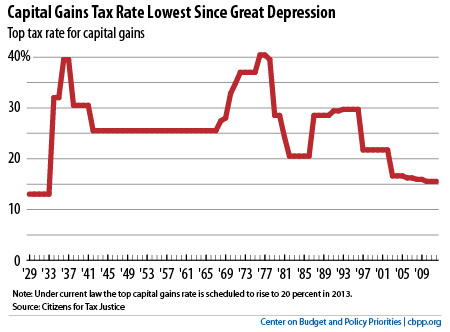
Are the incumbent's positions not reinforced in today's environment? There are 3,618 publicly traded companies today compared to 6,407 in 1987 [1]. Is that a sign of positive competition? Today's capital gains rate is the lowest since the Depression [2]. Yet, entrepreneurial activity is at generational lows [3].


Further, paying capital gains at say 50% on 10% returns for 20 years is better than paying 0% capital gains on 6% returns for 20 years.