When I was applying to grad school for applied math, one place I applied was the Division of Applied Math at Brown University. I had a business trip to the small jet engine shop of GE in Lynn, MA, so went down to Brown to meet some profs. Had lunch. Talked. I got one piece of advice: "Stay away from the Navier-Stokes equations."
Yup, good advice.
The Navier-Stokes equations are old stuff now. Basically they are just Newton's second law, the gas law, etc. -- just basic physics. If you want to calculate the flows of fluids -- liquids and/or gasses -- from first principles of the basic physics, then you are stuck with the Navier-Stokes equations. It's like calculating the trajectory of a home run baseball -- need Newton's second law, the law of gravity, and at least something first cut on air resistance (right, in fine detail, the air resistance would again be the Navier-Stokes equations but good enough for a baseball or artillery shell, there are some good enough, simple approximations).
Or for calculating what fluids do, from the basic physics, that is, from what we DO know about the basic physics, we just can't avoid the Navier-Stokes equations anymore than for the baseball we can avoid Newton's second law force = mass times acceleration. Yup, this is a case were we know too much: We DO know that, for calculating from a solid basis, that is, from first principles, for the math we need, we DO have the equations and they are just the Navier-Stokes equations. Sorry 'bout that.
You mentioned that you noticed that the Navier-Stokes equations are complicated math -- right!
As I mentioned, maybe we can do well with the Navier-Stokes equations for some boat hull or some airplane wing. Okay. Early in my career, I got started on the Navier-Stokes equations at the US Naval Ship R&D Center at Carderock, MD -- right, with the big towing tank used for designing ship hulls. That was before the guy at Brown told me "stay away from the" equations. He was right!
So, you are correct: Trying to solve the Navier-Stokes equations for all the oceans and all the atmosphere of the earth is a wild thigh slapper, absurd, out of the question. We don't have such a computer. Even if we did, we don't have even the required initial conditions -- that is, the current state of the flows in the oceans and the atmosphere. Or, we are stuck-o.
We will also want to know that the Navier-Stokes equations are nicely stable, that is, that a butterfly flapping its wings in NY will not cause rain instead of sunshine in Japan (to borrow from various movies). IIRC, Richard Bellman wrote his Princeton dissertation on the stability of ordinary differential equations -- IIRC the stability of the Navier-Stokes equations is a challenging topic, e.g., appears to be part of one of the Clay Math problems along with P versus NP, etc.
And the real problem is still worse: E.g., likely we would have to handle turbulence, known to be difficult. When I was at Carderock, there was a guy working on turblence; he had been for years; maybe he is still there still working on turbulence; maybe in another 100 years he will have some good progress! In principle, we are talking about handling winds blowing through trees (would need the details on all the leaves of all the trees!!!) and the resulting turbulence. Would need some good details on associated biology. Would need .... And after have all of that, as the climate started to change, we would need good details on how the biology would change, and we don't have any equations from first principles for that.
So, why do we need to do the fluid flow calculations? Well, we're talking about CO2. For that, we want to know where it goes, e.g., into the water, out of the water, into/out of seashells into the upper atmosphere, close to the ground, as it warms, as in the greenhouse effect, where it goes, sucked up by the plants, reacts with rocks, etc.
So, what people have done is use various assumptions, simplifications, and approximations. It's a little like in freshman physics where we assume a block slides down a plane, and the plane has no friction, or a ball rolls down a plane and we ignore the moment of inertia of the ball.
So, people tried such approximations, etc. We DO know the basic physics, and a big part of that is the Navier-Stokes equations. And we have more physics on the black body radiation that is the source of the infrared radiation that is the source of the warming of the CO2 that is the warming of the greenhouse effect. We have a lot of the basic physics and chemistry. And that basic science just does not tell us that there are some nice, easy approximations that will let us predict the climate.
E.g., suppose some day during the years we are predicting, it rains. It might! Then after the rains, where is the CO2? Do we have partially carbonated rain water? In principle, we will want to know where the CO2 goes. So, part of our calculation will be to predict when it rains. Hmm ....
Yes, as is often the case in physics, for some purposes we can just use the law of conservation of energy, calculate energy into the earth from the sun and energy out of the earth from radiation to space and get the balance and temperature change. Okay. But the details, if we want them, of the energy in and energy out will take us back to the Navier-Stokes equations. So, maybe we can make some simplifying assumptions. Apparently then ... we come up with the models that predicted much higher temperatures by now.
Then, in all of this, we have an assumption that is now looking like week old dead fish: It's all about the greenhouse effect and CO2 and not something else. What "something else"?
Apparently an argument can be made that, really, at anything like currently realistic levels of CO2, CO2 and the greenhouse effect are essentially irrelevant and the main cause is just clouds from water droplets from cosmic rays blocked or not by the solar wind from sun spots. In that case, we can calculate all we want with the Navier-Stokes equations, make more bad predictions, and accumulate some big computer bills. So, for accurate predictions, we'd be into predicting the sun spot activity of the sun. Hmm .... Is that at all promising?
The lecture on geology and CO2 was really interesting: It got into the orbit of the earth, the power (energy per unit time) to the earth from solar radiation, some geology, and some tricky chemistry but not sun spots!
Net, so far, it's tough to predict either the weather or the climate. Sorry 'bout that! It's also tough to cure cancer, explain dark matter and dark energy, ..., etc.
"IAU, international astronomical organisation that brings together more than 10 000 professional astronomers from almost 100 countries:
The results, presented at the IAU XXIX General Assembly in Honolulu, Hawai`i, today, make it difficult to explain the observed changes in the climate that started in the 18th century and extended through the industrial revolution to the 20th century as being significantly influenced by natural solar trends.
The sunspot number is the only direct record of the evolution of the solar cycle over multiple centuries and is the longest scientific experiment still ongoing.
The apparent upward trend of solar activity between the 18th century and the late 20th century has now been identified as a major calibration error in the Group Sunspot Number. Now that this error has been corrected, solar activity appears to have remained relatively stable since the 1700s [3]."
So, there were measurements of larger, easier to see sun spots, all sun spots including small ones, and sun spot clusters. There have been some old records and also some data from some tricky chemistry on earth in some rocks or some such of effects of sun spots, data that goes way back, maybe thousands of years, maybe more. So, someone applied Kelley's Variable Constant and Fink's Finagle Factor with their thumb on the scale and corrected all the data and got, presto, bingo, wonder of wonders, a grant for CO2 research from the old Obama Administration?????
Even taking that article at face value, for discussing global warming, CO2, and sun spots, the article
doesn't look nearly as relevant as we would want. Actually it looks like it is knocking down arguments I was not making, picking arguments it could knock down, setting up straw men just to knock them down, and not very directly addressing global warming.
E.g., the article knocks down an argument about a long term, increasing "trend" of sun spots. Okay. I was never aware that anyone claimed that there was such a "trend".
E.g.,
apparently there have been claims of a recent "maximum" of sun spots, and the article claimed to knock down that claim, also. Gee, the article was the first I'd heard of any such "maximum" -- I was not arguing for such a "maximum".
It remains that the Little Ice Age was darned cold, and it was in force when Washington crossed the Delaware and Napoleon returned from Moscow. IIRC from the last time I looked up The Little Ice Age on Wikipedia, the LIttle Ice Age lasted much longer than the link's relatively short interval for the Maunder Minimum.
Q. 1. So, what the heck caused the fall in temperature at the beginning of the Little Ice Age?
A. 1. Apparently no one is arguing, or has data on, lower CO2 concentrations as the cause. So, CO2 is not the only cause of global cooling.
Then, sure, cancel that cause, i.e., suppose whatever it was it goes away, and we should see some global warming without considering CO2 unless there was lower CO2 at the beginning of the cooling.
Q. 2. What got us out of the Little Ice Age?
A. 2. Maybe CO2 from the Industrial Revolution? Or maybe the earth just returned to what it was doing before it got cold, whatever the cause of that warmer globe was, and not CO2.
that's really sad stuff; I'm sorry to see the UCS push that stuff: So, they argue that to the best they know how, just "natural" can't explain the temperature variations. Then in their models, they put in what they believe would be the effects of CO2 and, presto, bingo, wonder of wonders, and I can believe after some appropiate debugging and grant from the Obama Administration, the model fits old history. That's weaker than over cooked pasta.
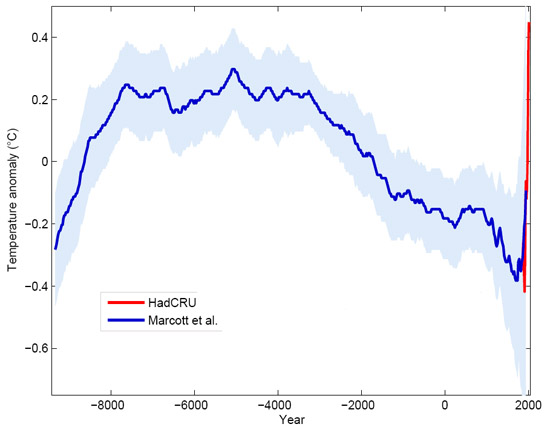
Didn't one of those links mention how warm it is now? I don't believe it is especially warm now: From what I've seen, there's been no significant increase in temperature for the past 16 or so years. So, in particular the temperature is essentially the same as in year 2006 when the NAS report I referenced claimed that the temperature in 2006 was essentially the same as in year 1000 before any influence from human sources of CO2.
I can't be very sure about the sun spot explanation, but to me it looks much better than the CO2 explanation.
Net, I don't see work that lets us predict the temperature 100 years from now other than just guess "no change".
Also, in just simple terms from lots of just simple temperature evidence, I see no reason for alarm.
Indeed in your circumlocutive manner you have described a task akin to building a sand castle one grain of sand at a time. You're getting into the territory of pascals demon. If you could produce such a sophisticated model why would you even bother with the weather since you'd be able to produce so much more than than that!
What you describe sounds quixotic. Tilting at windmills. I would be very disappointed indeed to discover that climate science floundered in the face of trying to do the impossible.
The history of innovation is littered with stories of impasse quickly followed by the discovery of a short cut and then progress. It's all about short cuts. When I play chess I don't evaluate all possible moves - when I play poker I don't count the cards. Yet - I can play both quite effectively. How is this? Because dispite my incapability to grasp all the variables I can develop quite sophisticated models with effective predictive power.
Nobody expects the sciences to be exhaustive down to the atomic level. Not all sciences are physics. All that is required is a framework into which all extant knowledge can be integrated; methodology for gathering new data and a means to extrapolate predictions.
As a software engineer I'm never expected to write x86 assembly language to implement a functioning web site. All I need to do is read a book on HTML look at a few examples online and then off I go. I can probably do a better web site than the guy writing the ASM code for a living.
That is what using your NS equations is like for computing your boat hull. Far better off reviewing other people's accounts of what works and putting them together - testing - and seeing if it works. Yes there are a great number of edge cases you may never be able to account for but there are only so many hours in a day and you need to produce something that works for the case in point - not all possible situations.
And so it goes with climate science - you can't possibly predict everything to this minutist detail - you can only observe and measure, observe and measure, catalogue, and integrate and continue as infinitum continuously refining your models. Some stuff won't integrate like other stuff but eventually you'll get to a point where you start to have some predictable capacity. By definition this approach can never be "complete" but as we discuss "completeness" isn't possible.
But what we do have from our catalogued observations and measurements is a huuuuge body of knowledge about what "actually does happen". Nothing is ever that wildly out of the blue that our existing knowledge and modelling can't have some premonition of it. There are exceptions of course but like we say without doing the impossible it isn't possible to foresee these ...
But what we can do is, to within a certain degree of certainty make predictions about what is likely to happen. Like if you're swimming in a lake in Africa or something and you see a shimmering movement on the water do you wait to compute that it's just an agglomeration of leaves? Do you wait to see if it moves with the characteristic vortices of a crocodile or so you just GET THE FUCK OUT OF THE WATER straight away?
I know which is be doing. Even if it means all my friends laughing at me because sure I'll feel a little bit embarrassed but in the alternative reality where it was a crocodile but I gave up trying to exhaustively model what it was I have died a horrible and brutal death.
So as much as I appreciate your educational pedigree and thank you for sharing your valuable time with me I do remain sceptical of your scepticism. Though you have conclusively demonstrated what we cannot know you have said little to explain what we do and our corroborating experiences heretofore. Hope this doesn't come across as too much of a circumlocutive gish gallop I've been trying to type this on my phone on the train without recourse to any notes or any editing capabilities. Sorry 'bout that ;-)
Your view of a lot of the methodology in science, and more so in engineering, is correct or nearly so, and I agree with it nearly so.
BUT!!!! So far in saying what human sources of CO2 will do to the temperature of the earth, as in the graph at the link I gave, we're in deep, fuming, reeking, brown sticky stuff -- the predictions from nearly all the models were badly wrong.
So, one approach to something better is to return to first principles of physics. History shows that that approach has been known to work. And IIRC by now the Navier-Stokes equations have been quite good for boat hulls and airplane wings. But as I outlined and you noticed, using first principles to say what the temperature of earth will be in 100 years is too difficult, absurdly too difficult, even if ignore turbulence around leaves, too darned difficult -- and it might even be unstable. So, that approach won't work, either.
So, as you outlined, we need to find a way that does work. In such a case we will need to check it, test it, validate it, etc. And at this point, from the graphs, no one but 10 year old sweet, cute, darling, adorable but gullible and naive Virginia will believe any testing based on predicting old data and, instead, will want a prediction of the NEXT 20 years and the WAIT 20 years to take the work seriously.
Soooo, right, we fall back to some back of the envelope approaches.
Here's one such I've already explained here:
(1) For CO2, for nearly everything in the record for the past 800,000 years
(the geologic time intervals in the lecture seem to be different) shows that temperature went up without preceding CO2 concentrations going up and temperature went down without preceding CO2 concentrations going down. So, net, CO2 is not nearly the only cause of temperature changes. And, since we are now willing to do first cut approximations, we conclude in practical terms that, under anything like current conditions, CO2 is irrelevant. Bluntly, the variations in CO2 concentrations don't match the variations in temperature worth a darn.
(2) The stuff I outlined about sun spots fit the temperature data much better. The example that sticks out like sore thumb is the Little Ice Age -- that is, the Maunder Minimum after guy Maunder who noticed that there were nearly no sun spots during the Little Ice Age.
Otherwise, so far we don't know even as much as dip squat about the change in temperature, from CO2 or anything else, in the next 100 years. Clearly the first cut, safe bet is that there won't be any change.
And, it helps a lot that currently the temperature and the changes in temperature don't look at all unusual. I.e., it was hotter in the Medieval times when people were growing grapes in England.
Or, worry about if going to get cancer and f'get about CO2. Sure as heck f'get about carbon taxes.


Yup, good advice.
The Navier-Stokes equations are old stuff now. Basically they are just Newton's second law, the gas law, etc. -- just basic physics. If you want to calculate the flows of fluids -- liquids and/or gasses -- from first principles of the basic physics, then you are stuck with the Navier-Stokes equations. It's like calculating the trajectory of a home run baseball -- need Newton's second law, the law of gravity, and at least something first cut on air resistance (right, in fine detail, the air resistance would again be the Navier-Stokes equations but good enough for a baseball or artillery shell, there are some good enough, simple approximations).
Or for calculating what fluids do, from the basic physics, that is, from what we DO know about the basic physics, we just can't avoid the Navier-Stokes equations anymore than for the baseball we can avoid Newton's second law force = mass times acceleration. Yup, this is a case were we know too much: We DO know that, for calculating from a solid basis, that is, from first principles, for the math we need, we DO have the equations and they are just the Navier-Stokes equations. Sorry 'bout that.
You mentioned that you noticed that the Navier-Stokes equations are complicated math -- right!
As I mentioned, maybe we can do well with the Navier-Stokes equations for some boat hull or some airplane wing. Okay. Early in my career, I got started on the Navier-Stokes equations at the US Naval Ship R&D Center at Carderock, MD -- right, with the big towing tank used for designing ship hulls. That was before the guy at Brown told me "stay away from the" equations. He was right!
So, you are correct: Trying to solve the Navier-Stokes equations for all the oceans and all the atmosphere of the earth is a wild thigh slapper, absurd, out of the question. We don't have such a computer. Even if we did, we don't have even the required initial conditions -- that is, the current state of the flows in the oceans and the atmosphere. Or, we are stuck-o.
We will also want to know that the Navier-Stokes equations are nicely stable, that is, that a butterfly flapping its wings in NY will not cause rain instead of sunshine in Japan (to borrow from various movies). IIRC, Richard Bellman wrote his Princeton dissertation on the stability of ordinary differential equations -- IIRC the stability of the Navier-Stokes equations is a challenging topic, e.g., appears to be part of one of the Clay Math problems along with P versus NP, etc.
And the real problem is still worse: E.g., likely we would have to handle turbulence, known to be difficult. When I was at Carderock, there was a guy working on turblence; he had been for years; maybe he is still there still working on turbulence; maybe in another 100 years he will have some good progress! In principle, we are talking about handling winds blowing through trees (would need the details on all the leaves of all the trees!!!) and the resulting turbulence. Would need some good details on associated biology. Would need .... And after have all of that, as the climate started to change, we would need good details on how the biology would change, and we don't have any equations from first principles for that.
So, why do we need to do the fluid flow calculations? Well, we're talking about CO2. For that, we want to know where it goes, e.g., into the water, out of the water, into/out of seashells into the upper atmosphere, close to the ground, as it warms, as in the greenhouse effect, where it goes, sucked up by the plants, reacts with rocks, etc.
So, what people have done is use various assumptions, simplifications, and approximations. It's a little like in freshman physics where we assume a block slides down a plane, and the plane has no friction, or a ball rolls down a plane and we ignore the moment of inertia of the ball.
So, people tried such approximations, etc. We DO know the basic physics, and a big part of that is the Navier-Stokes equations. And we have more physics on the black body radiation that is the source of the infrared radiation that is the source of the warming of the CO2 that is the warming of the greenhouse effect. We have a lot of the basic physics and chemistry. And that basic science just does not tell us that there are some nice, easy approximations that will let us predict the climate.
E.g., suppose some day during the years we are predicting, it rains. It might! Then after the rains, where is the CO2? Do we have partially carbonated rain water? In principle, we will want to know where the CO2 goes. So, part of our calculation will be to predict when it rains. Hmm ....
Yes, as is often the case in physics, for some purposes we can just use the law of conservation of energy, calculate energy into the earth from the sun and energy out of the earth from radiation to space and get the balance and temperature change. Okay. But the details, if we want them, of the energy in and energy out will take us back to the Navier-Stokes equations. So, maybe we can make some simplifying assumptions. Apparently then ... we come up with the models that predicted much higher temperatures by now.
Then, in all of this, we have an assumption that is now looking like week old dead fish: It's all about the greenhouse effect and CO2 and not something else. What "something else"?
Apparently an argument can be made that, really, at anything like currently realistic levels of CO2, CO2 and the greenhouse effect are essentially irrelevant and the main cause is just clouds from water droplets from cosmic rays blocked or not by the solar wind from sun spots. In that case, we can calculate all we want with the Navier-Stokes equations, make more bad predictions, and accumulate some big computer bills. So, for accurate predictions, we'd be into predicting the sun spot activity of the sun. Hmm .... Is that at all promising?
The lecture on geology and CO2 was really interesting: It got into the orbit of the earth, the power (energy per unit time) to the earth from solar radiation, some geology, and some tricky chemistry but not sun spots!
Net, so far, it's tough to predict either the weather or the climate. Sorry 'bout that! It's also tough to cure cancer, explain dark matter and dark energy, ..., etc.